RESSH2026: Scientific Autonomy Under Pressure – Conference proceedings
EASSH member ENRESSH led the delivery of this important event which encouraged research evaluation to consider the full diversity of research across all disciplines. Discover the conference proceedings.
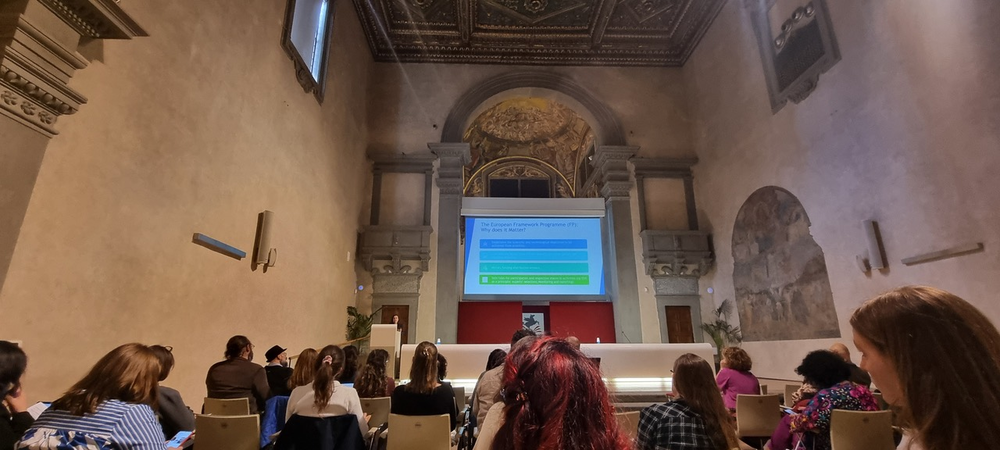
The RESSH2026 conference took place in Florence, Italy, on 2224 April. The theme of RESSH 2026 was “Scientific Autonomy Under Pressure: Rethinking Research Evaluation in the Context of Global Power Shifts, Security Concerns, and Artificial Intelligence Challenges”. It gathered scholars, policymakers, research managers and practitioners from 30 countries. The breadth of representation underscores the global importance of the questions under discussion.
The conference is the regular event of the international association and EASSH member ENRESSH – European Network for Research Evaluation in the Social Sciences and Humanities. “It brings together specialists in research evaluation and policy, with a particular focus on the social sciences, humanities, and the arts” (RESSH20206 conference website). Many EASSH members were present, contributing to the discussions around this year’s theme.

Michael Ochsner, ENRESSH, of the programme & scientific committees states:
“Since its founding, ENRESSH has established RESSH as the leading international forum for the critical examination of research evaluation, particularly in the Social Sciences and Humanities (SSH). RESSH builds a community of scholars, policymakers, and practitioners whose collective efforts have significantly influenced both the field of research evaluation and the reform agendas emerging at European and national levels.”
“The contributions collected in the proceedings span conceptual, empirical and policy-oriented perspectives. They address key transformations in research evaluation across SSH disciplines and beyond and reflect a wide range of methodological approaches, including case studies, theoretical work, quantitative analyses, surveys, legal analysis.”
Gabi Lombardo, EASSH Director:
“The RESSH conference was an exceptional gathering of a truly global community committed to advancing research evaluation reform. The presentations and papers combined rigorous scholarship with deep policy insight, reflecting the participants engagement on both fronts. Most importantly, the conference played a meaningful role in reshaping how countries approach research assessment. Encouraging more equitable, inclusive, and representative systems that recognize the full diversity of research across all disciplines.
The research community plays a role in the wider debate and in the negotiation. Scholars organised in university associations, academies, disciplinary alliances are investing greatly to have their voice heard at this critical time. The European Alliance for SSH is working in this space, at the interface of the research community of Art, Humanities and Social Sciences and policymakers.”
The keynotes
Gabi Lombardo had a keynote address where she presented her paper, “Funding Research in time of crises”, and asked the following: "Even within the current EC (MFF) proposal, a more familiar tension is being played out over the balance between research and innovation. Innovation seems to be understood only in terms of AI and deep tech. So, what is happening to other forms of innovation, what space is there for the innovation that provides social benefits, and creates ‘social value’ to our societies? What about the innovation that fosters corporate sustainability and social progress beyond economic returns?"
Gabi Lombardo addressed the audience:
“We live in complicated times and the research community today more than ever must engage with the design of the European research funding programme, because research goes beyond peers’ recognition, but constitute the ground for a collective social responsibility at time of crisis. The next Framework Programme is not just a funding instrument. It is a political signal. It is a statement about what we believe, what we value and what kind of Europe we are committed to building. Let’s ensure it reflects the full complexity, and humanity, of that task.
The second keynote was by Francesca Di Donato, National Research Council, Institute of Computational linguistics "Antonio Zampolli" (CNR-ILC), addressing “Open science, research assessment reform, and autonomy of research(ers). A critical discussion”. The objective of this contribution was: “to emphasise the critical interrelationships between open science, research autonomy and the ongoing reform of research evaluation, which involves institutions and researchers.”
Francesca Di Donato stated:
“Both Kant’s and Humboldt’s conceptions of open science as an open-ended collaborative process pose research autonomy at their core. As such, they offer a framework that supports open science, placing the autonomy of research, researchers, and institutions at its core.
This model can serve as a paradigm for open science both foreshadowing contemporary contradictions and suggesting how to address them. Importantly, the case of Prussia adopting the Humboldtian conception of higher education shows that scientific autonomy and openness of science is a successful policy response to a situation of internal and external challenges.
Preserving the autonomy of research from political and economic influence remains a core responsibility of democratic governments and institutions. In an age where technology, and AI in particular, is instrumental in decision-making processes, it is imperative to deliberate on strategies to ensure transparency and accountability, and to have public open infrastructures platforms and tools for that.
This means increasing funding to public research institutions and open infrastructures, reversing trends towards the underfunding of research and precarious nature of academic careers; recognising their full independence and pluralistic nature – including with regard to the evaluation of research; and creating the conditions for scientific communities to assume collective ownership and control over the infrastructures necessary for science and its assessment, reversing the trend towards the outsourcing of technological infrastructure management to private companies; while questioning who is evaluating, controlling and directing scientific research”.

Conference proceedings
The conference proceedings bring together conceptual, empirical, and policy-orientated contributions that examine how research evaluation is changing across the Social Sciences and Humanities (SSH) and related fields. They address key transformations in research evaluation across SSH disciplines and beyond. Using diverse approaches such as case studies, theoretical analyses, surveys, quantitative research, and legal perspectives, the contributions explore the growing pressures on scientific autonomy in a context shaped by geopolitical power shifts, security concerns, and rapid technological change.
The collection of contributions will also be shared as part of the outputs for the CoARA WG Evaluating Social Sciences and Humanities (SSH) Research Globally.
The abstracts provided in the conference proceedings cover the following topics:
- 1.1 Artificial intelligence and research evaluation
- 1.2 Research evaluation reforms, governance and scientific autonomy
- 2.1 Quality, values and conceptual frameworks
- 2.2a Research evaluation practices across institutional and peripheral contexts
- 2.2b Co-creation, collaboration and open bibliometric Infrastructure to account for diversity
- 2.3a Multilingualism across disciplines and research evaluation
- 2.3b Career, gender and effects of evaluation
- 2.4a Criteria, excellence and dynamics in research evaluation
- 2.4b Governance and politics of research systems
- 2.5 Societal impact and public engagement
- 3.1 Open research and infrastructure
- 3.2 Bibliometrics, LLMs and research integrity
- 3.3 Rethinking indicators, metrics and evaluation tools for SSH.
There were also a poster session and a book launch, The Knowledge of Humanities by Andrea Bonaccorsi (2026): First Monograph in the Brepols’ Series “Research on Research in the Arts, Humanities and Social Sciences”. EASSH is in touch with the author, professor Bonaccorsi, for an in-person presentation of her book in Brussels.
Download the conference proceedings (284 pages) on the conference website or directly here.
The next RESSH conference will be held in 2028 and EASSH will contribute to the design of the programme.